Board on Board Wood Fence with Cap Rail, Orlando
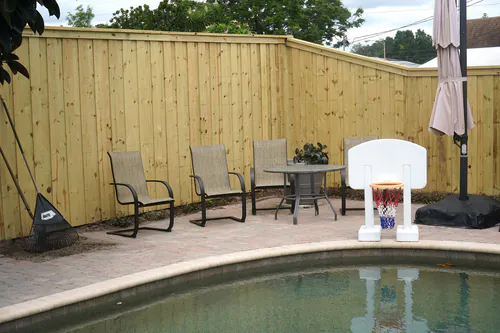
- FenceBoard on board privacy with cap rail
- LocationOrlando, Orange County, Florida
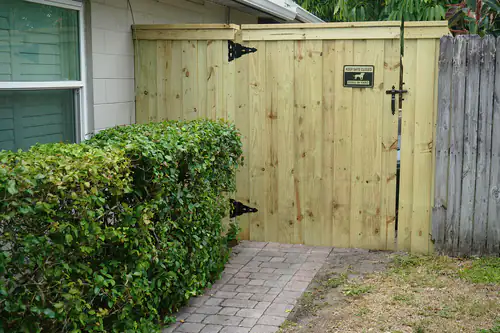
- IncludedWide gate on heavy strap hinges
- Site notesPool patio enclosure beside an older fence
Board on board means the boards overlap instead of sitting edge to edge. It uses noticeably more timber than a standard stockade fence, and homeowners always ask why it costs more. The answer shows up two summers later, when the boards have dried and shrunk and a normal fence starts letting daylight through between every one of them.
An overlapped fence has nowhere to open up. This Orlando run also carries a cap rail, the horizontal board across the top that hides the end grain and gives the fence a finished edge, and it wraps a pool patio with paver decking. The gate photo shows the other end of the same job, hung on black strap hinges next to a much older fence that has already done its graying.
Put the two side by side and the comparison makes itself. New treated pine on the left, twenty seasons of Florida sun on the right. Both were somebody's new fence once, and the difference between them is mostly a matter of how the timber was specified and how the tops were finished.
Why choose board on board over a standard privacy fence?
Because it stays private. A conventional stockade fence butts each picket against the next, and that joint is only tight while the timber holds the moisture it arrived with. Pine shrinks as it dries. Every board pulls back a fraction, and the sum of those fractions is a set of vertical gaps you can see your neighbor's yard through.
Board on board overlaps each board across the one behind it, usually by an inch or more, so the timber can shrink the full amount and the overlap simply reduces. There is still no gap. It costs more up front in boards and in labor, and it is heavier, so the posts and rails have to be sized for it. For a pool enclosure or a yard that backs directly onto another house it is generally worth it, and it is one of the builds covered by our wood fence installation.
What does the cap rail on top actually do?
It protects the boards and finishes the line. Cut end grain on the top of a picket drinks water straight down into the board, which is exactly how a wood fence starts rotting from the top rather than the ground. A cap rail lays flat across those ends and sheds the rain off instead.
Visually it does as much again. A capped fence has one clean horizontal line across the top instead of a row of individual board ends, which is the difference between a fence that looks built and one that looks assembled. It also stiffens the whole run, because that top board ties every picket to its neighbors and back to the posts. On the pool side you can see how much the cap matters against a flat paver deck, where any wobble in the top line would be obvious from every seat on the patio. Getting that line true is a good part of what you are paying for in a professional fence installation.
What has to be right about a wood gate around a pool?
The hardware and the code, and the hardware is where most gates fail. A board on board gate is heavy, far heavier than the panel beside it, and a light hinge will let it sag within a season until it drags on the pavers and stops latching. The gate here is hung on long black strap hinges that spread the load across the frame rather than concentrating it on a small plate.
The code side is not optional. Florida's residential pool safety law sets requirements for barriers around a swimming pool, including a minimum barrier height and a gate that is self closing and self latching with the latch placed out of a small child's reach. Requirements change and local enforcement varies, so confirm the current rules with Orange County or your municipality before you build, and we will build the enclosure to meet what applies to your property. If an existing fence is the problem rather than the plan, our fence repair and fence removal crews handle that first.
Enclosing a pool or a back yard in Orlando?
We will look at the run, the gate opening and what the barrier rules require, then put it in writing. Call Byers Fence at (386) 457-2045 for a free estimate.