Tan Vinyl Privacy Fence in Winter Garden, Florida
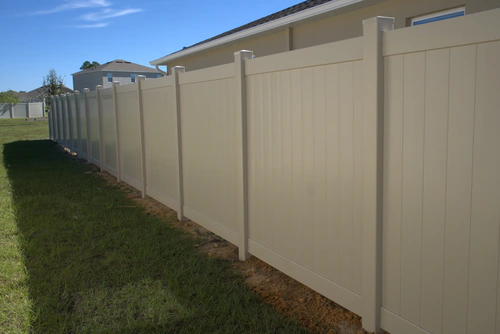
- FenceTan vinyl privacy panels
- LocationWinter Garden, Orange County, Florida
- IncludedSide yard run starting at the house corner
- Site notesNew construction lot on trucked in clay fill
New house, new lot, new fence. This run starts at the corner of a Winter Garden home and heads down the side of the property toward the back. Look past the panels and you can see the neighbors' roofs sitting close enough to explain why the owners wanted solid privacy panel rather than picket.
The orange strip along the base is the giveaway that this is new construction. That is fill the builder brought in, and it is clay rather than the sand you find under an older Central Florida yard. It digs differently, it drains differently and it keeps settling for longer, all of which changes how the posts get set.
The rest is ordinary tan vinyl privacy panel. Flat top rail, matching post caps, and the run holding level while the ground underneath it does whatever it wants. That white fence visible two lots over belongs to another house in the same subdivision, which is usually a sign that an association has already decided what is allowed here and what is not.
What is different about fencing a brand new construction lot?
The ground, mostly. A finished subdivision lot is not natural soil. It is fill that was trucked in, spread and compacted to the grade the builder needed, and on this job that fill is the orange clay you can see along the base of the run. Clay holds water. A post hole in it can still have an inch standing in the bottom hours after the rain stopped.
It also keeps moving. Fill settles for a good while after a house is finished, which is why a fence built the month the keys change hands occasionally needs a post reset later, and why we would rather go deeper than the minimum on a lot like this one. Then there is the question of what is buried. Irrigation lines, low voltage lighting, downspout drains and the builder's own service runs all sit in the first foot or two of soil, and most of them never show up on a locate ticket, because a locate covers utilities rather than anything the builder put in afterwards. We probe before we dig on new lots for exactly that reason. Our fence installation page has more on how a job runs from the estimate through to cleanup.
Where exactly should a new fence sit on the property line?
Just inside it, and you want a survey rather than an opinion. On a new build the survey is easy to lay hands on, because one was produced for the closing and it is sitting in the folder from the title company. It shows the corner pins and the exact dimensions of the lot, and it settles an argument that is a great deal harder to settle once the concrete has cured.
Sitting the run a little inside the line buys two things. The posts and their concrete stay entirely on your property, and you keep a narrow strip on the far side you can reach without stepping into the neighbor's yard, which matters the first time a panel needs a rinse. Lots in newer Winter Garden subdivisions sit close together, so that strip is often only a few inches wide, and the width is worth deciding on purpose. There is usually a second layer to work through as well. Most newer neighborhoods in Orange County run an association with its own rules on fence height, color and how far forward of the house a fence may start, and approval takes time, so start that paperwork before you book a crew. The colors and heights typically allowed are listed on our vinyl fence installation page.
Why do so many new Winter Garden homes end up with tan vinyl?
Because it is usually the color the association already approved, and because it disappears against the stucco most of these houses are finished in. Look at where the panel meets the wall in the photo and there is barely a line between them. White vinyl on a sand colored house does the opposite and pulls the eye straight to the fence.
The material choice is more practical than aesthetic. A new homeowner has just absorbed a closing, and a wood privacy fence always looks cheaper on the estimate. The honest comparison is not day one, it is what each fence costs across the years you plan to be in the house. Vinyl asks for a rinse. Pressure treated wood in Central Florida asks for a clean and a reseal every couple of years, and the boards will still cup and gray between treatments. If you want the timber look without the timber schedule, woodgrain vinyl is the middle ground, and there is a cypress colored example in the Byers Fence project portfolio. Our wood fence installation page lays out what the real maintenance cycle looks like if you would rather have the genuine article.
Just closed on a new build?
Bring us the survey and the association rules and we will price the run against both. Free estimates, no obligation. Call Byers Fence at (386) 457-2045.