Cypress Vinyl Fence and Gate in Longwood, Florida
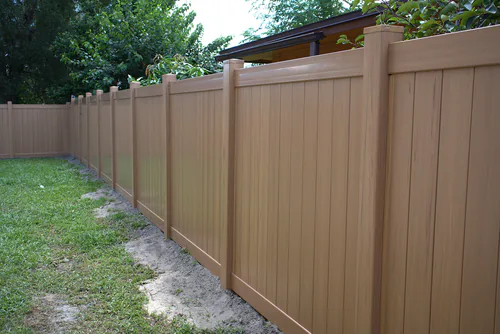
- FenceCypress woodgrain vinyl privacy panels
- LocationLongwood, Seminole County, Florida
- IncludedWalk gate with black self latching hardware
- Site notesNew run tied into a neighbor's existing wood fence
Cypress is a color here, not a species. The panels carry a printed woodgrain and a warm brown tone, so from the patio this Longwood run reads as a stained board fence. Nobody is ever going to stain it.
The first photo looks straight down the rear line, and the strip of turned soil along the base is what tells you the crew left that week. That trench is where the old fence came out and where the new post holes went in. Two months of Florida summer and the grass closes back over it.
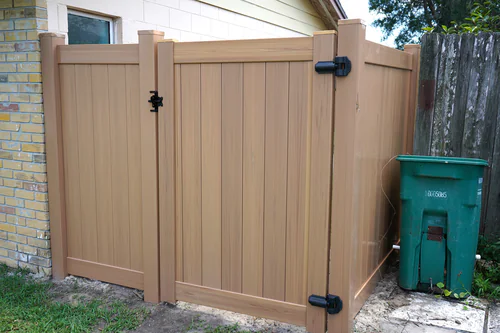
The second photo is the more useful one, and it is the one homeowners tend to stop on. It shows the walk gate on the side of the house, squeezed between a painted brick wall and the neighbor's weathered gray wood fence. Look at where the new cypress panel meets that old fence. That junction is the part of a fence job nobody photographs and every crew has to solve.
How do you tie a new vinyl fence into a neighbor's old wood fence?
Carefully, and after a conversation with the neighbor. The rule we work to is that the new fence gets its own post rather than fastening to somebody else's, because the day that old wood fence comes down, ours should not be coming down with it. You can see the result in the second photo. Two separate fences meeting at a corner, each standing on its own.
That does mean the two runs end up close together instead of sharing a line, and there is usually a narrow gap where they meet. On this job the last panel was cut so the gap is something you have to look for rather than something you notice. It also means the new post has to go on our client's side of the boundary, which is a survey question and not a judgment call. Old fences drift. A fence built in the nineties sitting six inches inside the line is common enough, and matching it because it looks right is exactly how a boundary quietly moves. If the neighbor's fence is the real problem rather than the backdrop, our fence removal and fence repair crews can price taking it out or putting it right while we are already on site.
What hardware goes on a gate that gets used every day?
Black powder coated hinges and a gravity latch, and both cost more than the versions on the shelf at a big box store. That is deliberate. This is the gate that opens every time somebody takes the trash out, walks the dog or drags a hose to the front, so it will see more cycles in a year than the rest of the fence sees in a decade.
Vinyl gates need hardware sized for a hollow frame. The hinges in this photo bolt through the gate post rather than screwing into the face of it, and the latch drops shut under its own weight instead of relying on somebody remembering to turn back. Look at the ground clearance while you are there. There is a deliberate gap under the leaf so the gate does not scrape when the soil swells after a storm, and so it still swings over grass that has grown since spring. If a gate is going to form part of a pool barrier the hardware requirements get stricter and the latch height is regulated, so confirm the current rules with Seminole County before ordering. Gate styles and panel colors are on our vinyl fence installation page.
Why is there a strip of bare dirt along a new fence line?
Because a post hole produces more soil than it takes back. Every hole along that run came out at the depth this ground needs, the concrete went in, and the fill that came back around it does not all fit. What is left gets raked flat along the line, and that is the pale strip running down the first photo.
We leave it flat rather than mounding it against the panels, and there is a reason for that. Soil piled up the face of a vinyl fence traps moisture and holds mulch and clippings against the bottom rail, and damp organic material sitting against vinyl is where the green film starts. Left low, the run dries out after rain and a hose handles the rest once or twice a year. The bare strip has one more use before it disappears. It is the last chance to sight down the fence line while it is still visible and check the run is genuinely straight, because grass hides a surprising amount of wander. Give it a couple of months and the trench will have closed over completely. There are more finished runs to compare in the Byers Fence project portfolio, and our Longwood fence installation page covers working in this part of Seminole County.
Replacing an old wood fence?
We will walk the line with you, price the removal and the new run together, and bring the cypress sample out so you can hold it against the house. Call Byers Fence at (386) 457-2045.