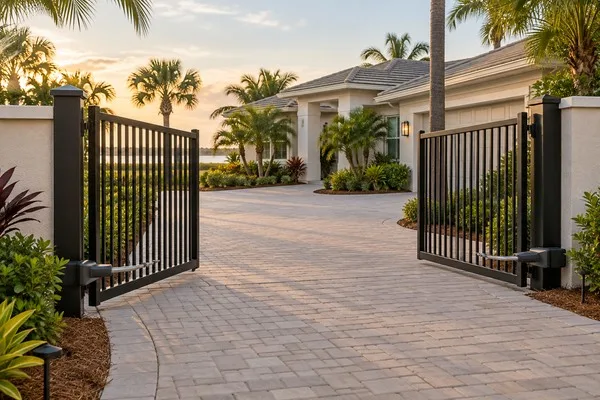
A swing gate is usually the simpler, lower cost choice for a flat driveway with open space inside the gate. A slide gate fits better on sloped or short driveways, or anywhere a swinging leaf would block cars, boats, or trailers. Both can be manual or automatic, and both can match your existing fence. Fence contractors who build gates often will tell you the driveway decides more than the catalog does, so reach out to our team or call (386) 457-2045 to talk through yours.
Swing gate or slide gate: which fits your driveway's slope and space?
Swing gates need a flat or gently sloped area and enough clear room for the gate to open inward. Slide gates need a clear stretch of fence line beside the opening where the gate can roll back.
Start with the slope. A swing gate that opens uphill will drag on the pavement unless it is hung high or built to rake, while a slide gate rolls along a track or on cantilever rollers and does not care much about the grade behind it. Then measure the swing. A 12 foot double swing gate needs about six feet of clear arc on each side, and anything parked in that arc becomes a problem.
That is exactly what happened with one customer. She loved the idea of a swing gate, and we started sketching out how it would work until her husband pointed out that it would interfere with his fishing boat. Every time he left the house, it would turn into a game of Tetris. We set them up with a more practical choice for how they actually use the driveway. Around Daytona Beach, with so many families trailering boats to the Halifax River and Ponce Inlet, that conversation comes up a lot. As a fence contractor in Daytona Beach, we look at the boat, the cars, and the slope before recommending a gate style.
How do costs and manual versus automatic openers compare?
Swing gates usually cost less to build and automate, while slide gates cost more but solve tight or sloped driveways. Automatic openers add cost to either style but make the gate far easier to use every day.
A manual gate is the budget option and works fine if you only close it at night. Most homeowners who want security and privacy end up wanting an opener, though, because nobody enjoys getting out of the car in a summer downpour to drag a gate open. Openers for swing gates mount on the gate and post. Slide gate operators sit beside the opening and drive the gate with a chain or gear. Solar powered kits are available too, though our afternoon storm season means you want a battery backup either way.
Safety matters more with automation. Automatic gates are built and installed to two voluntary industry standards, UL 325 for the operator and ASTM F2200 for the gate itself. According to an installer's guide to ASTM F2200 from DASMA, a swing gate should keep at least 16 inches of clearance from fixed objects, and manual latches have to come off any gate that gets an automatic operator. A contractor who knows these rules builds them in from the start.
How do fence contractors match a driveway gate to your existing fence?
Match the gate's material, color, and top line to the fence it connects to, and scale up the frame and posts so the gate can carry its own weight. Done well, the gate looks like it was always part of the fence.
The gate should feel like a continuation, not an add-on. If your yard has a white vinyl privacy fence, a matching vinyl or aluminum frame with a privacy infill keeps the look consistent. A black aluminum fence pairs with a black aluminum gate in the same picket style. Wood fences can get a wood-faced gate on a steel or aluminum frame, which keeps the gate from sagging under its own weight over the years.
Posts matter more than most people realize. A driveway gate is far heavier and swings far more often than a walk gate, so it needs bigger posts set deeper in concrete. In older neighborhoods like Seabreeze, where homes have character and tighter lots, we often design the gate to complement the house as much as the fence. Ask your contractor to show you the gate frame and hinge hardware, not just the finished look.
Which gate materials hold up best against salt air?
Powder coated aluminum is the top pick near the coast because it does not rust. Pair it with stainless steel or coated hardware so the hinges, rollers, and latches last as long as the gate.
Salt air is tough on metal. Plain steel gates near the beach can show rust within a few seasons, and once rust gets under the paint, it spreads. Aluminum resists corrosion, weighs less, and puts less strain on hinges and openers. Vinyl also works well for privacy gates near the coast, as long as it is built on a sturdy internal frame. Wood can work if you are willing to keep up with sealing.
The hardware deserves just as much attention. Hinges, rollers, and opener parts take a beating from salt and humidity, so ask for stainless or marine-grade options and plan on rinsing the gate now and then. Browse our project gallery to see finished gates and fences. When you are ready to choose, call Byers Fence at (386) 457-2045 or book a consultation, and we will help you pick the gate that fits your driveway.