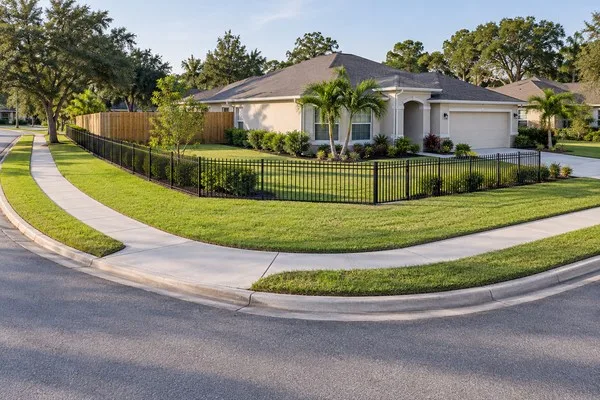
On a corner lot in Deltona, you can usually fence your side and rear yards at full privacy height, but the parts facing either street come with lower height limits and a clear sight area near the intersection. Get those two things right and the rest of the project is straightforward. Experienced fence contractors handle the survey, the layout, and the permit for you, so reach out to our team or call (386) 457-2045 before the first post hole gets dug.
What are the sight triangle and setback rules for a corner lot fence?
A sight triangle is the area near an intersection where fences, walls, and tall plants are restricted so drivers can see cross traffic. Setbacks are the distances a fence has to stay back from property lines, rights of way, and easements.
Corner lots are tricky because you have two street frontages instead of one. That means two sides of your yard get treated more like a front yard, and the corner itself falls inside the sight area where a solid six foot fence is not allowed. Drivers pulling up to a stop sign need to see kids on bikes and cars coming around the bend, so cities take this seriously. Build into that zone and you may be told to cut the fence down or move it.
Deltona has a lot of these lots. The city grew out of a planned community with long, curving residential streets, and the many intersections along roads like Providence Boulevard and Normandy Boulevard create plenty of corner properties. Easements matter too. Utility and drainage easements often run along side and rear lines, and fencing over them can mean taking the fence down if a utility crew needs access. As a fence contractor in Deltona, we check the sight area, setbacks, and easements before we draw a single line.
How tall can a fence be in the front, side, and rear yards in Deltona?
Deltona generally allows taller fences on side and rear yards than in front yards. A corner lot has to follow the front yard limit along both street sides in many cases, which is where most confusion comes from.
A 2020 Volusia County staff report on fence heights that compared local rules listed Deltona as allowing a five foot fence in the front yard and six feet on side and rear yards. Rules can change, and corner lots and sight triangles have their own limits, so we confirm the current code with the city for every job. Permit requirements depend on the fence's height and location too.
In practice, that usually shapes a corner lot design like this. A six foot privacy fence wraps the true backyard. Along the street side, the fence either steps down to the lower height or sits back far enough to be treated as a side or rear fence. Near the corner itself, it stays out of the sight area entirely. The result can still give you a private backyard. It just takes planning, and a layout that looks fine on paper can fail once you measure from the actual property line and the edge of the road.
How do fence contractors use the survey to place posts correctly?
Start with your boundary survey, find the property corners in the field, and lay out the fence from those points, not from the sidewalk or the neighbor's hedge. Then mark the setbacks and the sight area before anything gets dug.
Many homeowners assume their yard ends at the sidewalk. On a corner lot in Deltona, the city right of way often extends some distance past the curb, and the actual property line can be several feet inside the sidewalk. Building on that guess is how fences end up on city land. Your survey shows the real lines, the easements, and often the corner pins.
One customer a while back had set out little garden flags to mark where he wanted his fence, so he could make a private sitting area on his corner lot. Before any concrete was poured, we sat down with him and talked through the survey and the visibility requirements. That conversation is what kept the project legal. If your corner pins are missing, have a surveyor re-stake them. It costs far less than moving a fence after the fact.
Which fence material works best on a highly visible corner lot?
Pick a material that looks good from both sides, because on a corner lot the whole street sees your fence. Wood and vinyl are the most common choices, and both can be built with a finished face toward the road.
A corner fence is basically part of your home's curb appeal. Wood gives a warm, natural look, and a shadowbox or board-on-board style looks finished from both sides, which matters when neighbors and drivers see the outside every day. Our wood fences are a favorite for homeowners who want that classic look. In Deltona's humidity, plan to seal or stain wood every few years to slow graying and warping. Vinyl costs more up front but needs almost no upkeep, and aluminum or a shorter picket style works well for the lower street side sections.
Mixing heights and styles is normal on corner lots. A six foot privacy section in back can transition into a four foot picket section along the street and still look like one design. When you want a corner lot fence that is legal, private, and good looking, call Byers Fence at (386) 457-2045 or contact us, and we will handle the survey, layout, and permit.