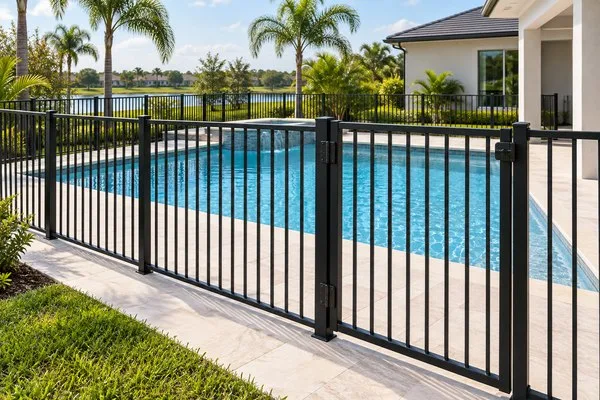
A pool fence in Sanford has to meet Florida's residential pool barrier law: at least four feet tall, no gaps a small child can squeeze through, and gates that open outward and close and latch on their own. The good news is that a well designed aluminum fence checks every one of those boxes while keeping your backyard open. Working with fence contractors who know the code makes the permit and inspection painless, so reach out to our team or call (386) 457-2045 to get started.
What does Florida code require for a residential pool fence?
Florida law requires a pool barrier at least four feet high, measured on the outside, that surrounds the pool and leaves no openings a young child could crawl under, squeeze through, or climb. Gates must open outward, away from the pool, and be self-closing and self-latching.
That comes from the Florida Residential Swimming Pool Safety Act. It also says the barrier has to sit far enough from the water's edge that a child or a frail older adult cannot fall straight into the pool after getting past it. And your yard fence can only double as the pool barrier if it sits on the pool's perimeter and meets every one of those rules itself.
The Florida Building Code then adds more precise measurements for things like opening sizes and latch height. That is where a lot of DIY fences and bargain installs fail inspection. In Sanford, a new pool fence typically goes through a city permit and a final inspection, and the inspector checks those details closely. We work as a fence contractor in Sanford every week, so we build to the code from the first post, not after an inspector finds a problem. One more tip: if you are adding a pool to an existing yard, ask about the barrier before the pool contractor pours the deck. Post placement is much easier to plan then.
Why is aluminum fencing such a popular choice around pools?
Aluminum gives you a code compliant barrier you can see right through. It also holds up to Florida sun, rain, and pool chemicals without rusting.
Picket spacing is the big advantage. Pool rated aluminum panels keep the gaps between pickets tight enough for code while leaving the view wide open, so you can watch the pool from the kitchen window or the lanai. Solid privacy fences block that line of sight, which is the exact opposite of what most families want around water. Aluminum also does not rot or need painting, and the powder coated finish shrugs off the humidity that rolls in off Lake Monroe on summer afternoons.
Style matters too. Many homes in Sanford, from the older neighborhoods near downtown to newer subdivisions out west, look best with a simple black aluminum fence that almost disappears against the landscaping. Flat top and spear top styles each have their fans. We usually steer families with young kids toward a flat top rail design without horizontal rails on the outside that a child could use as a ladder. Our aluminum fences come in pool rated options built for exactly this job.
What self-closing, self-latching gate hardware should fence contractors install?
Choose a gate that swings outward, closes on its own from any open position, and latches every time without anyone touching it. The latch release should sit high on the pool side, well out of a small child's reach.
The gate is the weakest point of any pool barrier, because it is the part people actually use. Cheap spring hinges lose tension, sag in the heat, and stop pulling the gate all the way shut. A gate that closes but does not latch is no barrier at all. Look for adjustable, rust resistant self-closing hinges and a magnetic or gravity latch designed for pools. Then test it. Open the gate partway, let go, and watch. It should close and click every single time.
One sweet Sanford grandmother we worked with wanted a nice view of the pool area from her kitchen, but she also wanted a fence for security. Her grandchildren visited a lot, and she did not want them to have easy access to the water. She paid more attention to the gate mechanism than anything else in the whole project. She was right to. Ask your installer to walk you through how the hinge tension adjusts, so you can keep the gate working properly for years.
How do you balance child safety with keeping the backyard open?
Fence the pool itself rather than the whole yard, place the gates where traffic naturally flows, and choose a see-through design. That keeps kids safe without turning your backyard into a cage.
Fencing just the pool area leaves open lawn for play while putting a real barrier between children and the water. Good fence contractors will ask how people move through the yard before they mark a single gate. A gate near the back door means nobody props it open as a shortcut. A second gate on the far side can make it easier to get mowers and pool equipment in and out. Layer in other protections too, like door alarms on any house door that opens toward the pool and a pool cover when the water is not in use.
Keep the barrier clear. Patio chairs, planters, and pool toys pushed against the fence turn into step stools for curious kids. When you are ready to plan a pool fence that passes inspection and still looks good, call Byers Fence at (386) 457-2045 or schedule your estimate today.